Thursday, December 8, 2011

making a passport photo

This is quite a simple task yet not as easy as one might assume as passport photos usually need to be made according to certain specifications and the size might vary between countries.

Here are the specifications for the Indian Visa/ Passport photo followed by the UK ones. They are worth reading in as much as they give one a basic understanding of the complexities involved in making such a simple photograph or just responding to the request of "Can you take my photo please!"

I have done the image at the required 2 by 2 inch size and then put six of these on to a 6 by 4 print so the photos can easily be made when required.

From the photographer's point of view, a standard lens needs to be used (a slightly longer than standard 80mm would work well) while the background needs to be plain.


INDIAN VISA PHOTO SPECIFICATIONS

http://in.vfsglobal.co.uk/touristvisa_photospecs.html

It is imperative that the photograph submitted at the time of application must fall within the specifications and sizes given below. Applicants can obtain the correct specification photograph from the coin operated vending machine available at the visa application centres. Applicants can get two photographs instantly at a nominal cost of a £4.
Unacceptable photographs, that do not meet the specifications, may not be accepted for submission.

Sample Photograph:

The photograph should be in color and of the size of 2 inch x 2 inch (50 mm x 50 mm).
The photo-print should be clear and with a continuous-tone quality.
It should have full face, front view, eyes open.
Photo should present full head from top of hair to bottom of chin.
Center head within frame.
The background should be a plain light colored background.
There should not be any distracting shadows on the face or on the background.
Head coverings are not permitted except for religious reasons, but the facial features from bottom of chin to top of forehead and both edges of the face must be clearly shown.
The expression on the face should look natural.

Do’s and Don’ts for a Proper photograph

The photo should capture full face, front view, with eyes open.
The head should be in the centre of the frame.
There should be no distracting shadows on the face or background.


Make sure photo presents full head from top of hair to bottom of chin; height of head should measure 1 inch to 1-3/8 inches (25 mm to 35 mm). Make sure eye height is between 1- 1/8 inches to 1-3.


Lighting on face and background

The light should be even and balanced to avoid shadows on the face.
Background behind the face should be properly illuminated to avoid shadows in the background.

Photograph Print Properties

The photograph should be in size 2 inch x 2 inch (50 mm x 50 mm) and in color.
Print photo on thin photo paper.
Ensure the print is clear and has a continuous-tone quality.
Do not retouch or otherwise enhance or soften the photo.
Resolution and Printing Quality/Contrast and Colour

High-resolution photography and printing are strongly recommended.
Both conventional and digital photography are acceptable, and conventional or digital printing methods may be used.
Resulting print should exhibit a continuous-tone quality regardless of the print method used (dye sublimation, ink jet, laser, etc.)
Digitally printed photos should be produced without visible pixels or dot patterns
Fine facial features should be discernible.
Brightness and contrast should be adjusted to present the subjectand background accurately.
Photos without proper contrast or color may obscure unique facial features.
Color should reproduce natural skin tones.
Fluorescent or other lighting with
Unbalanced color may cause unwanted color cast in the photo. Appropriate filters can eliminate improper color balance.
Head & Eyes- Position and Background

Head should face the camera directly and should not tilt or turned (portrait style).
Photo must show both edges of the face clearly.
The eyes must be open, level and clearly visible and must not be covered by hairs or eyeglass frames.
Eyeglasses

Glare on eyeglasses should be avoided with a slight upward or downward tilt of the head.
No tinted or dark glasses.
Head coverings are not permitted except for religious reasons, but the facial features from bottom of chin to top of forehead and both edges of the face must be clearly shown.

Exposure and Lighting

There should not be any over-exposure or underexposure which results in an unusable photo.
There should be a three-point balanced lighting. Facial features should be clearly evident in the photo.
Lighting should be adjusted to avoid shadows on the face or background. Diffuse sources of light, such as umbrella lights, are preferable to point sources.
Flexibility in Children’s photographs

Babies under one year do not have to have their eyes open.
As regards the photograph of the children under ten years of age, requirements can be somewhat relaxed in respect of height of the face and the position of the eyes in the photographs; and in case of babies and infants also, the position of the face, the facial expression, the eyes and the line of sight can have some relaxation. However, a frontal photograph with clarity is required for children.
It should show the child alone (no chair backs, toys or other people visible) looking at the camera with a neutral expression and the mouth closed.


UK PASSPORT PHOTO SPECIFICATIONS

The rules for passport photos

The photographs you supply with your application must:
  • show you with a neutral expression and your mouth closed (no grinning, frowning or raised eyebrows)
  • show you on your own (babies should not have toys or a dummy, and there shouldn’t be other people in the photo)
  • be in colour, not black and white
  • be identical
  • be taken within the last month
  • be 45 millimetres high x 35 millimetres wide - this is the standard size when you have a passport photo taken in a photo booth or studio (you should not trim a larger photograph to meet this condition)
  • be clear and in sharp focus, with a clear difference between your face and the background
  • be taken against a plain cream or plain light grey background
  • not show you with red-eye
  • be of you facing forward and looking straight at the camera
  • not be torn, creased, or marked 
  • be printed on plain white photographic paper
  • be free from shadows
  • be taken with your eyes open and clearly visible (no sunglasses or tinted glasses and no hair across your eyes)
  • be free from reflection or glare on your glasses, and the frames must not cover your eyes - the Identity and Passport Service (IPS) recommends that, if possible, you remove your glasses
  • be professionally printed (photographs printed at home are not acceptable)
  • show your full head, without any head covering, unless you wear one for religious beliefs or medical reasons
  • be taken with nothing covering your face - you should make sure nothing covers the outline of your eyes, nose or mouth
  • be a close-up of your head and shoulders with a recommended head height (the distance between the bottom of your chin and the crown of your head) between 29 and 34 mm
  • not have any writing on the front or back, except on certified photos - trademarks or photographic printing on the back must not show through


Friday, November 18, 2011

Hereford Photography Festival


Seeing work exhibited at Hereford, I decided to look at it in terms of People and Place.

For a more general introduction to the day visit at The Hereford Photography Festival 2011 ...


The main exhibition of the festival was called "Time and Motion Studies: new documentary photography beyond the decisive moment" which featured work by five separate photographers. We are told by Simon Bainbridge, editor of The British Journal of Photography and festival curator, that "each employs a carefully thought-out strategy for their study, a methodology by which to transcribe and communicate ideas about the world, tackling subjects that aren’t always obviously photogenic."


The first group of images we see are by Vanessa Winship made in Georgia between 2009 and 2010. These are high quality black and white images made with a large format camera and black and white film  printed on to black and white paper giving a quality that one does not see with digital. There are no captions to the photographs; some have blank backgrounds, others give a sense of place. The people who are pictured, all seem to be under 30, both male and female; there is a kind of "ethereal beauty" to these portraits and it is evident that she was looking for people who reflected her imagined view. She sees Georgia as "a place that seemed to be in love with it's own idea of self."


www.vanessawinship.com


Winship travelled with George Georgiou whose images were on show in the main part of the gallery. Called "The Shadow of the Bear" a reference to the Russian influence in Serbia and Kosovo where these photographs were made, these were a succession of still images the significance of which was not immediately apparent; they seemed to have no narrative and not in any particular order as one could read them up and down or from one side to another. There were two large prints that stand out among the smaller ones; of these two larger ones, the image of a well but scantily clad woman in what looked like silk is standing in the middle of a road as if trying to hitch a ride. Is she a prostitute or a well dressed lady waiting for a lift, part of a marriage party perhaps; the male gaze is likely to understand this differently to the female one! The woman's face is pointed away from the camera which further adds to the mystery of this image.


www.georgegeorgiou.net


Manuel Vasquez has a video installation (Lonely Crowd 1 and 2) which showed people moving around in a space, the limits of which were unclear. There are also some very large photographs that reflect a similar scene of people passing in a public space without interacting. These are high contrast scenes with the background being lost in shadow; in the prints, compositing seems to have been done. These images are about surveillance, "In a society full of prying eyes like ours, everyone can become both spectator and actor in the quotidian spectacle." They were shot in Madrid's Atocha train station, site of the 2004 terrorist attack.


www.manuelv.net


The most startling images were of people playing video games, another exhibit that contained both still and video. A special camera was used here, The Red One, which captures both video and high resolution images. The range of emotions that these people display is considerable;hey knew they were being photographed yet consciously this appears to be something they have forgotten as they become obsessively involved in their games. This work is by Robbie Cooper who aims to capture a ceratin naturalness in his subjects even if they are not behaving naturally.


www.robbiecooper.org


The final series of photographs are by Donald Weber, a Canadian working in the Ukraine, who took years to get permission to photograph inside an interrogation room. The people who come here are suspected of minor crimes and the photographer waits until they finally confess thereby capturing the emotions they display at the time. Although the subjects give their permission to be photographed, this work raises ethical questions as people are sharing private moments of remorse. The images are all tinged by dull orange tones characteristic of photographs made under indoor lighting. The exhibition space is narrow and confining, not unlike the room in which the images are made.


www.donaldweber.com


Entrance to the Hereford Art Museum


This exhibition was shown at the Art Museum in Hereford. For the other exhibition of note that we visited, Solsbury, it was necessary to walk about a mile to Hereford Art College where the exhibition was being held. Initially, I was put off by the political content but the pictures were well made black and white prints (even though they had been digitally printed) by someone who was actively involved rather than a bystander.


The exhibition marks 15 years since the road protest of 1994 where a number of protestors took to the trees in an attempt to prevent a road being made through woodland. These images are well composed and capture private moments of the demonstrators in the trees although other images show them being dragged away by security guards. Defiance is captured here and this body of work succeeds in highlighting the injustice of the situation, often lost in media reports.


Some images are quite amusing such as a man with a baby Magpie on his head, the Magpie having been disturbed from it's nest owing to the chopping down of the forest, yet still manage to make a point. The image that advertises the exhibition as a whole is both simple and lyrical, showing a protestor swinging in mid-air. Other images show the danger some protestor's put themselves in which created an even bigger problem to the guards evicting them who could not afford to cause any kind of accident even though they were obviously contemptuous of those they were arresting.


This kind of work might be considered dated but it is refreshing!


Looking at Photographs - Jose Navarro and Gareth Dent of the OCA


Wednesday, October 19, 2011

Rephotographing at Lacock

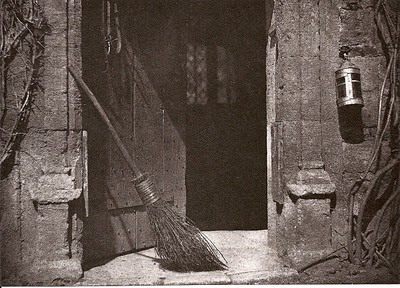
Since I was visiting Lacock, the former home of Fox Talbot and where the photographic negative was invented, I decided to do some rephotographing.

The day before i visited a bureau in town to make laser copies of Fox Talbot's different views of the house; my intention was to relocate these and photograph them as they are today. The juxtaposition between some of the first ever photographs made and the present day interested me!

I was able to locate all the views thanks to some help from staff! Each Fox Talbot view is followed by my rephotograph ...


Looking at the two photographs above, one can see that the doorway appears narrower in the original; this can be explained by the fact that I was using a wide-angle 18mm focal length where Fox Talbot would have been using a more standard length of lens.


In the second series of images, one might well wonder whether it is the same door in both photographs. It seems likely but a new door has obviously been fitted while there have been changes inside since one can no longer see a window in the background.


The difference between the two photographs here is immense and reveals just how far photography has come in the 180 years of it's existence with detail both on the inside the window and without. Having said this, one can marvel at the first negative and a camera that can produce an image with very little distortion.

Thursday, October 13, 2011

Julia Margaret Cameron

I began this series of posts about People and Place by discussing the work of David Bailey and also Richard Avedon; this was partly by coincidence and so I wanted to include another portrait photographer whose work is quite different and yet something I find inspiring.

First, a little about Julia Margaret Cameron ...

Julia Margaret Cameron (1815-1879) was born in Calcutta in 1815, one of seven daughters to a man known as "the biggest liar in India". After being educated in Europe, she returned to the Cape of Good Hope where she met Charles Hay Cameron, whom she married in 1838. On Charles's retirement in 1848, they moved to London where Julia became part of Kensington's artistic community, including poet Henry Taylor, painter G.F. Watts and Poet Laureate Alfred, Lord Tennyson. The gift of a camera from one of her daughters in 1863 sparked an enthusiasm in Julia Margaret Cameron for this new art form. Within a year she had begun to present her friends with albums of her work and was elected a member of the Photographic Society in London. She outraged society by becoming an experimental photographer, though because of her refusal to "retouch", many considered her a bungling amateur. Then, in 1875, at the peak of her fame as photographer, her husband wanted to return to his sons in India so that he might be with them for his last years. She gave it all up, and the Camerons departed for Ceylon.

I consider her work worthy of consideration not just because it is classed as great photographer but also because she was operating at a time when techniques were quite different owing to the limitations placed on early photographers by the medium. For instance, the portrait photographer often had to request their subjects to hold a pose for long periods of time. This resulted in rather forced poses as well as blurred or soft focus faces.

It is interesting to note that a book about her entitled "Julia Margaret Cameron: The Complete Photographs" published by Thames and Hudson in 2003 is now being sold for over £1,000 although one can pick up new copies for £375. The original price was probably about £25.

I am looking for the monograph that was published by The National Portrait Gallery at the time of thie exhibition of her work; it does not seen to be available on Amazon. In the meantime, I have ordered a book in Phaidon's 55 series about Great Portrait Photographers as she is one of them.

Wednesday, October 12, 2011

National Portrait Galllery photographic workshop afternoon of saturday jan 29'th 2011


I had lunch in the National Portrait Gallery restaurant. On the walls, were a couple of black and white photographs from the 1960's which seemed to conform almost perfectly to the rule of thirds owing to the way the head was positioned in the frame!

I seem to have developed a more post-modern outlook and find this kind of composition rather too formalist particularly when it involves a blending of the subject with the background.

The Indians : 150 years of portrait photography ; 2 - a portrait of Moraji Desai and a viewer's projection

In the book of Indian portraits by Raghu Rai discussed earlier, there is a photo of Moraji Desai, a former prime minister of India who lived to be almost 100 years old, and who was responsible for the jailing of his rival, Mrs. Indira Gandhi. It is an image that makes me laugh because it reveals the man as a bit of a "goonda" (a Hindi word that means ruffian yet when anglicised also implies foolishness).

Another photographer raised an objection to this photograph because it has apparently been photoshopped with the white of the khadi cloth that Desai is wearing being a slightly darker colour. This other photographer felt it was disrespectful since however "dirty" a politician Desai might have been, his khadi was always white.

I decided to ask Raghu Rai about this to ascertain his reasons for doing so. Was he motivated to portray Desai in this way?

The first thing that Raghu pointed out was that the image had not been photoshopped. It was one that he no longer has the negative of and so the print had been scanned.

To make an effective print, Raghu needed to burn in the detail of the hat and cloth and hence they appear darker; there was no attempt on his side to portray Desai as a dirty politician by darkening his khadi !!

Raghu Rai then went on to reveal how the detail in the clothes contrasted with the detail in the face of Desai and the way in which this lay at the heart of the design of this photograph.

FINDING YOUR OWN VISION - 3 (Alex and Rebecca as photographers)

Alex's work seems to be mostly about places I don't know and have only marginal interest in but his Istanbul series is intriguing ...

http://www.webbnorriswebb.com/#mi=2&pt=1&pi=10000&s=0&p=6&a=1&at=0

DID HE MAKE THESE IMAGES AROUND THE TIME OF THE EARTHQUAKE THERE!? IF SO, WHAT IS HIS REAL INTEREST IN ISTANBUL! I WONDER HOW LONG HE STAYED THERE!

Rebecca's book, The Glass Between Us, is an interesting look at people watching animals that is composed almost entirely it seems of reflections in glass ...

http://www.webbnorriswebb.com/#mi=2&pt=1&pi=10000&s=0&p=0&a=1&at=1